















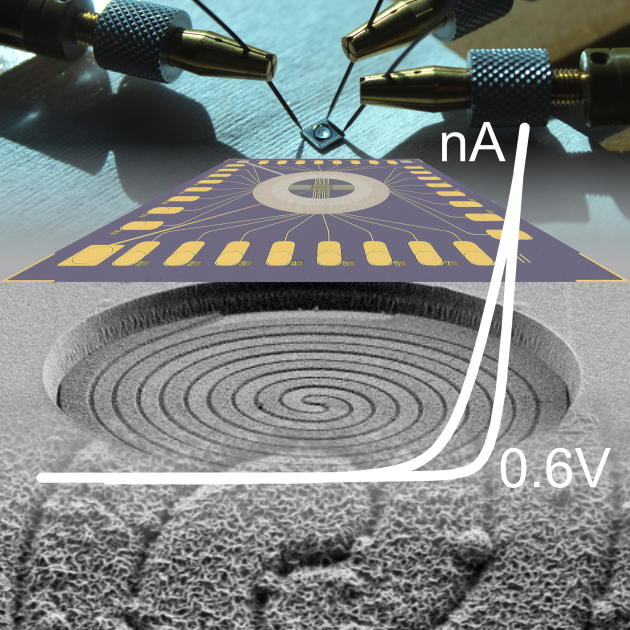
 Abstract: Fabricating electronic devices spoiling the least resources is of an increasingly high importance. Also, micro-electronics hardly embeds chemical functionalities on silicon, as soft materials suffer from harsh conditions of conventional processes. In thi s study, electrochemistry on a chip is investigated to pattern conductivity-based measurement devices at small scale via electropolymerization. To comply with additive manufacturing, a dewetting coating and local quasi-reference/counter micro-electrodes shall be integrated on each chip. The process reliability is challenged using minimalist chemical and energy resources, such that a microliter droplet of an electro-active solution composed mostly of a non-toxic and affordable solvent suffices to coat 16 elements on a 3x3 mm2 chip. Despite the complexity of electrochemistry at such scales, the coatings variability is dominated by the chemical composition of the droplet. Avoiding a vessel to confine large volumes of solutions and integrating all electrod es is required to reduce drastically the electrochemical signal noise. This demonstrates its sufficient stability to screen conducting polymer materials when their precursors are not available in large amount to be coated with conventional techniques. It also demonstrates its compliance for chips microfabrication using conducting polymers as functional materials for electrochemically-assisted additive manufacturing production.
Moustiez P., Guérin D., Pecqueur S.*

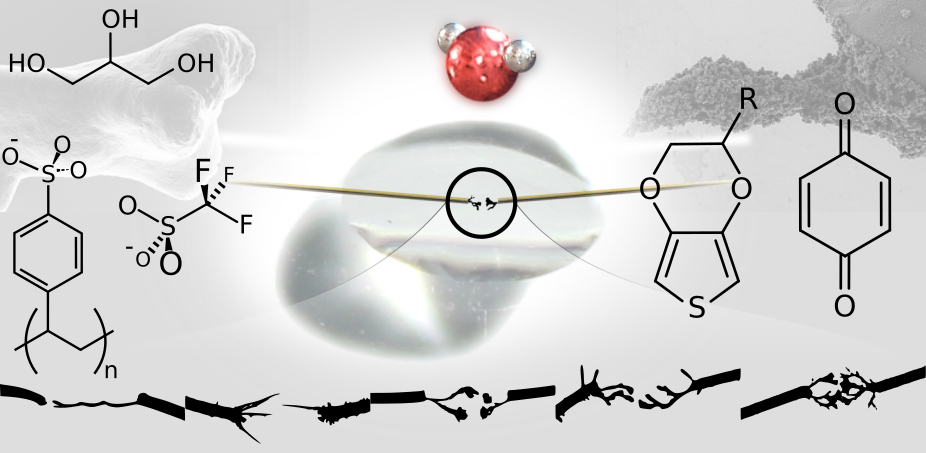 Abstract: Conducting polymer dendrite (CPD) morphogenesis is an electrochemical process that enables in materio evolving intelligence in wetware devices. During CPD morphogenesis, voltage transients drive the physical evolution of electrically conductive structure s, thereby programming their filtering properties as nonlinear analog devices. Either studied as an electrochemical experiment or as neuromorphic devices, the dependence of the electrical properties of the electrogenerated structures on the chemical comp osition of their growth environment is still unreported. In this study, we report the existing intrication between the nature and concentration of the electrolytes, electroactive compounds and co-solvents and the electrical and the electrochemical proper ties of CPDs in an aqueous electrolyte. CPDs exhibit various chemical sensitivities in water: Their morphology is highly dependent on the nature of the chemical resources available in their environment. The selection of these resources therefore critical ly influences morphogenesis. In addition, the concentration of the different electrochemical species have varying impacts on growth dynamics, conditioning the balance between thermodynamic and kinetic control on polymer electrosynthesis. By correlating t he dependencies of these evolving objects with the availability of the chemical resources in an aqueous environment, this study offers guidelines to tune the degree of evolution of electronic materials in water and highlights potential avenues for their application. Such evolving hardware is envisioned to exploit the chemical complexity of real-world environments as part of information processing technologies.
Baron A., Scholaert C., Guérin D., Coffinier Y., Alibart F., Pecqueur S.*
Abstract: Neuromorphic engineering is emerging as a promising approach for the next generation of Artificial Intelligence. While advances in bio-inspired algorithms and computing mechanisms strive to reproduce biology's capacity to adapt, learn continuously, and e volve within unstructured environments, significant breakthroughs are also needed at the hardware level. The diversification of materials and circuits, particularly through organic electronics, offers alternative solutions to current hardware, which prim arily relies on parallelization and increased computing resources. In this talk, we will present how electropolymerization of PEDOT-based materials can emulate biology's ability to define optimal computing topologies. We will demonstrate how a bottom-up approach to growing interconnections between nodes enables the discovery of optimal networks for specific tasks. In the second part of the presentation, we will discuss the integration of these dendritic networks onto 2D substrates. We will show how inte grated PEDOT networks and iono-electronic processes in organic electrochemical dendritic transistors can result in complex, non-linear signal transformations-supporting key computing functions used extensively in neural networks.
Scholaert C., Janzakova K., Balafrej I., Rouat J., Coffinier Y., Pecqueur S., Alibart F.
Abstract: Electropolymerization under an alternating-current results in the formation of conducting polymers dendrites (CPDs), that conduct both ionic matter and electronic charges simultaneously, offering features from both the worlds of electronics and electroch emistry. Versatile, they can be grown in various electrolytes to develop classes of electronic components that are evolvable and process information using mass-transfer mechanisms. By self-healing or resorbing, CPD have the potential to enable new functi onalities in conventional electronic systems with low material and energy costs, making them a promising avenue for bio-inspired information processing. They also offer a simple, low-voltage alternative to address the ongoing problem of high manufacturin g costs in the microelectronics industry. In this work, we investigate the control of poly(3,4-ethylenedioxythiophene) (PEDOT) based CPD morphology through electrolyte chemistry and its impact on impedance patterns in a two-electrode system, particularly in relation to their observed constant phase element (CPE) behavior. We also explore how morphology influences the charge/discharge dynamics when the dendritic connection is not yet completed. Specifically, it is shown that the electrical parameters of the CPDs, extracted by fitting the transient curves using the Mittag-Leffler function, are defined early during the growth, and that thicker CPDs will allow longer relaxation times. By changing the voltage pulse duration in the growth signal, one has the refore the ability to tune both the characteristic times and the non-ideality of a CPD charge. Ultimately, we aim to demonstrate the applicability of these concepts for programming sensors and integrating neuro-inspired functionalities into electronic no ses, which exploit electrochemistry for the recognition of complex environmental patterns.
Baron A., Scholaert C., Hernández-Balaguera E., Guérin D., Moustiez P., Coffinier Y., Alibart F., Pecqueur S.
Abstract: Conducting polymers are used in conductimetric transducers for many sensing technologies. On arrays, sensitive surfaces feature a large variety of materials: A clean process must be used to co-integrate them without threatening each material's integrity. As electrochemical technique, electropolymerization coats electrically-conductive materials with specific chemistries only on polarized electrodes without contaminating all others. As bottom-up deposition technique, it can be used to coat high-density a rrays at scales that are compatible with micro-electronics. The last decade has also shown the emergence of highly miniaturized potentiostat-galvanostat-impedance platforms, featuring all the necessary resources to communicate with external systems. Ther efore, material electrodeposition and impedimetric readout could practically be performed at very small dimensions and concomitantly on the same circuit board. Here, we present preliminary results on the use of miniaturized impedance analyzers and potent iostats to electropolymerize conducting polymers on a circuit board and to exploit electropolymerized coatings on arrays of microsensors, integrated into a miniaturized prototype. In a loop where a single circuit can supervise both its own manufacturing and its own environmental analysis, the study aims at paving the way for IoT objects embedding electrochemistry and machine-learning resources to support autonomously multi-material selections for electronic noses and tongues conception, directly on a bo ard.
Routier L., Toledo Nauto M., Guérin D., Moustiez P., Baron A., Lmimouni K., Coffinier Y., Hafsi B., Pecqueur S.
Abstract: In the recent challenge to decentralize microelectronics manufacturing (Eur Chip Act) while keeping our commitment to lower our environmental footprint (Eur Green Deal), processes to manufacture electronics must be additive and personalized. To this aim, electropolymerization on a chip could be a turning point to reinvent semiconductor deposition, not exploiting precious ores but synthetic precursors, additively with low wastes and energy consumption at manufacture, in ambient using electrochemistry. If electropolymerization is mastered on large-sized electrodes (mm2), materials behave however far differently at the micrometer scale, where isolated electropolymerized particles with large surface-over-volume ratio are destabilized, from electrode coatin gs to colloidal suspensions in the electrolyte. In this study, we investigate on structure-property relationships between the composition of an electrolyte (electroactive oligothiophenes solubilized in low volatility and toxicity solvents), the arrangeme nt of co-integrated quasi-reference (Ag) and counter (Pt/Au) microelectrodes to stabilize conducting polymer coatings locally on each working microelectrodes in an array of sensing elements. The coatings' electrical and morphological properties are highl y depending on the electrolytes and the set of monomers co-deposited at the same voltage. Important selections have to be made in regards to monomers' oxidation potential, their solubility in specific solvents and polymers' electroactivity, which control s both the electrical property of the sensors and the stability of the material in an iterative deposition process. By mastering electropolymerization on a chip, electrochemistry shall unlock a true bottleneck for multi-material co-integration to manufac ture highly integrated electronic noses and tongues.
Moustiez P., Guérin D., Baron A., Pecqueur S.
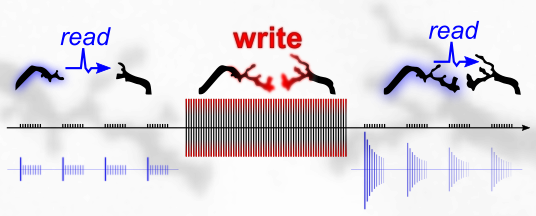 Abstract: Conventional electronics is founded on a paradigm where shaping perfect electrical elements is done at the fabrication plant, so as to make devices and systems identical, "eternally immutable". In nature, morphogenic evolutions are observed in most livin g organisms and exploit topological plasticity as a low-resource mechanism for in operando manufacturing and computation. Often fractal, the resulting topologies feature inherent disorder: a property which is never exploited in conventional electronics m anufacturing, while necessary for data generation and security in software. In this study, we present how such properties can be exploited to implement long-term and evolvable synaptic plasticity in an electronic hardware. The rich topology of conducting polymer dendrites (CPDs) is exploited to program the non-ideality of their electrochemical capacitances containing constant-phase-elements. Their evolution through structural changes alters the characteristic time constants for them to charge and discha rge with the applied voltage stimuli. Under a train of voltage spikes, the evolvable current relaxation of the electrochemical systems promotes short-term plasticity with timescales ranging from milliseconds to seconds. This large window depends on the t emporality of the voltage pulses used for reading, but also on the structure of a pair of CPDs on two electrodes, grown by voltage pulses. This study demonstrates how relevant physically transient and non-ideal electrochemical components can be exploited for unconventional electronics, with the aim to mimic a universal property of living organisms which could barely be replicated in a silicon monocrystal.
Baron A., Hernández-Balaguera E., Scholaert C., Alibart F., Pecqueur S.*
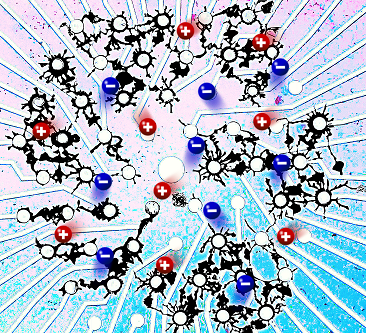 Abstract: Process variation has always been a challenge to mitigate in electronics. This especially holds true for organic semiconductors, where reproducibility concerns hinder industrialization. Challenging this concept, we show AC-electropolymerization to be a p owerful platform for the development of morphology-dependent computing hardware, thanks precisely to its intrinsic stochasticity. Our findings reveal that electropolymerized polymer dendrite networks exhibit a complex structure-operation relationship tha t allows to implement nearly linear to nonlinear functions. Moreover, dendritic networks can integrate a limitless number of inputs from their environment, which can be used to our advantage in the context of in materio computing to discriminate between different spatiotemporal inputs. These results position electropolymerization as a pivotal technique for the bottom-up implementation of computationally powerful objects. We anticipate this study to help shifting the negative perception of variability in the material science community and promote the electropolymerization framework as a foundation for the development of a new generation of hardware defined by its topological richness.
Scholaert C., Coffinier Y., Pecqueur S., Alibart F.*
 Abstract: This monograph describes nine years of research carried out at the Institute for Electronics, Micro-electronics and Nanotechnologies (IEMN), developed around defining a generic concept for detection, filling a void between metrological sensors and biolog ical senses, sensing an environment's qualities along with their measurable properties in information generation technologies. The first chapter introduces fundamental notions of recognition for complex environments, such as for their chemistry, for whic h organic semiconductors can embed two new functionalities in consumer electronics. The second and third chapters mostly summarize contributions to the state-of-the-art literature on these matters: in the second chapter, on studying conducting polymers a s both chemical detectors and conductimetric transducers, and the third chapter, on studying electropolymerization sensitivity to conceptualize evolutionary electronics. The fourth chapter presents several results on the conception of several "classifier s" exploiting both functionalities: in tasks aiming at integrating different sensitivities at a very small scale, at broadening sensing devices' receptive fields based on experience, and at physically engraving the experience data in a sensing hardware. Along with this monograph are also associated four appendices, summarizing different elements related to the context of this research.
© 2019-2026 Sébastien Pecqueur