
















Abstract: Electropolymerization under an alternating-current results in the formation of conducting polymers dendrites (CPDs), that conduct both ionic matter and electronic charges simultaneously, offering features from both the worlds of electronics and electroch emistry. Versatile, they can be grown in various electrolytes to develop classes of electronic components that are evolvable and process information using mass-transfer mechanisms. By self-healing or resorbing, CPD have the potential to enable new functi onalities in conventional electronic systems with low material and energy costs, making them a promising avenue for bio-inspired information processing. They also offer a simple, low-voltage alternative to address the ongoing problem of high manufacturin g costs in the microelectronics industry. In this work, we investigate the control of poly(3,4-ethylenedioxythiophene) (PEDOT) based CPD morphology through electrolyte chemistry and its impact on impedance patterns in a two-electrode system, particularly in relation to their observed constant phase element (CPE) behavior. We also explore how morphology influences the charge/discharge dynamics when the dendritic connection is not yet completed. Specifically, it is shown that the electrical parameters of the CPDs, extracted by fitting the transient curves using the Mittag-Leffler function, are defined early during the growth, and that thicker CPDs will allow longer relaxation times. By changing the voltage pulse duration in the growth signal, one has the refore the ability to tune both the characteristic times and the non-ideality of a CPD charge. Ultimately, we aim to demonstrate the applicability of these concepts for programming sensors and integrating neuro-inspired functionalities into electronic no ses, which exploit electrochemistry for the recognition of complex environmental patterns.
Baron A., Scholaert C., Hernández-Balaguera E., Guérin D., Moustiez P., Coffinier Y., Alibart F., Pecqueur S.


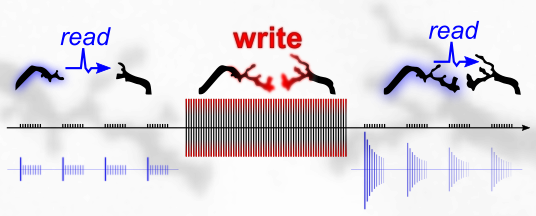 Abstract: Conventional electronics is founded on a paradigm where shaping perfect electrical elements is done at the fabrication plant, so as to make devices and systems identical, "eternally immutable". In nature, morphogenic evolutions are observed in most livin g organisms and exploit topological plasticity as a low-resource mechanism for in operando manufacturing and computation. Often fractal, the resulting topologies feature inherent disorder: a property which is never exploited in conventional electronics m anufacturing, while necessary for data generation and security in software. In this study, we present how such properties can be exploited to implement long-term and evolvable synaptic plasticity in an electronic hardware. The rich topology of conducting polymer dendrites (CPDs) is exploited to program the non-ideality of their electrochemical capacitances containing constant-phase-elements. Their evolution through structural changes alters the characteristic time constants for them to charge and discha rge with the applied voltage stimuli. Under a train of voltage spikes, the evolvable current relaxation of the electrochemical systems promotes short-term plasticity with timescales ranging from milliseconds to seconds. This large window depends on the t emporality of the voltage pulses used for reading, but also on the structure of a pair of CPDs on two electrodes, grown by voltage pulses. This study demonstrates how relevant physically transient and non-ideal electrochemical components can be exploited for unconventional electronics, with the aim to mimic a universal property of living organisms which could barely be replicated in a silicon monocrystal.
Baron A., Hernández-Balaguera E., Scholaert C., Alibart F., Pecqueur S.*
 Abstract: Conducting Polymer Dendrites (CPD) can engrave sophisticated patterns of electrical interconnects in their morphology, networking input with output nodes, from low-voltage spikes and with very minimal amounts of resources: they may unlock in operando man ufacturing functionalities for an electronics framework using metamorphism conjointly with electron transport as part of the information processing. The relationship between their structure and the information transport is still however very unclear and hinders the exploitation of the versatility of their morphologies to store and process electrodynamic information. This study details the evolution of CPD's circuit parameters with their growth and shape. By the means of electrochemical impedance spectro scopy (EIS), multiple distributions of relaxation times (DRT) are evidenced and evolve specifically upon growth. Correlations are established between the dispersive capacitance of dendritic morphologies and their growth duration, independently from exoge nous physical variables, such as distance, multi-component evaporation or aging. Deviation of the anomalous capacitance from the conventional Debye dielectric relaxation can be programmed within the morphology, as the growth controls the dispersion coeff icient of the dendrite's constant-phase elements relaxation. These results suggest that the fading-memory time window of pseudo-capacitive interconnects can practically be conditioned using electrogenerated CPD morphogenesis as an in materio learning mec hanism. This study confirms the perspective of using electrochemistry for unconventional electronics, engraving information with low voltage events in the physics of conducting polymer objects, and storing information in their morphology, accessible by i mpedance spectral analysis.
Baron A., Hernández-Balaguera E., Pecqueur S.*
Abstract: Conducting Polymer Dendrites (CPD) are truly inspiring for unconventional electronics that shapes topological circuitries evolving upon an application. Driven by electrochemical processes, an electrochemical impedance rules signal propagation from one no de to another. However, clear models dictating their behavior in an electroactive electrolyte have not been identified yet. In this study, we investigate on CPD in an aqueous electrolyte by impedance spectroscopy to unify their signal transport with an e lectrical model, aiming to define a circuit simulation block to integrate these objects in systems for in materio information processing.
Baron A., Hernández-Balaguera E., Pecqueur S.
© 2019-2026 Sébastien Pecqueur