
















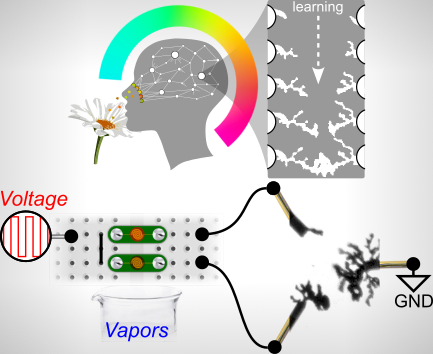
 Abstract: If electronics drives only electrons to charge electrodes, natural systems learn by moving matter to evolve. Morphogenesis in sessile organisms can be seen both as a fabrication process and as an operative mechanism. However, intricating manufacturing an d programming functionalities in electronic hardware is not conventional. In this study, we experimentally implement such a concept of an evolutionary electrical system using a neuro-inspired electronic nose as a model, to store a history of sensory data in the physical properties of the electrical interconnects of sensing elements. Triggered only by volatile molecule exposures, different sensing elements change instantaneously and reversibly their impedance, so pulse voltages enable the electrochemical growth of conducting polymer dendrites. The strength of the evolving interconnects is specific to the sensing materials and to the nature of volatile molecules to which they are exposed. The dendritic growths occur exclusively when exposed to volatile s amples, and stop immediately after interrupting the exposure. The capability of such "passive memory" was also assessed by simulating a network architecture, which showed that this way of storing information should greatly diminish the fabrication comple xity of a highly dense sensing array while realistically enabling its calibration to classify user-specific environment exposures. By demonstrating that memory in electronics can be a concept linked to manufacturing like in living organisms, this study s hows that low material resources and low voltage fabrication processes based on electrochemistry can be exploited for practical electronic applications in future-emerging sensing technologies.
Baron A., Hafsi B., Hernández-Balaguera E., Pecqueur S.*
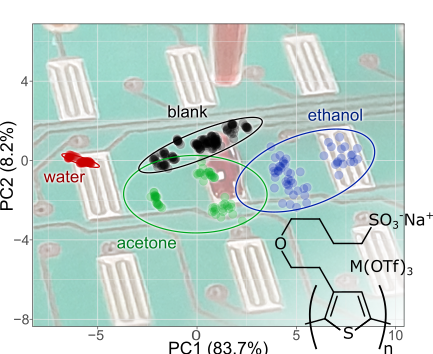 Abstract: Machine olfaction is still not embedded in portable devices. Relationships between electronic materials and chemical environments are hard to decipher to build phenomenologic models that formalize smells' and odors' subjectivity. Also, machine olfaction requires norms to generate large datasets: a generic technology, easy to manufacture and integrable to the broadest range of electronic devices must be identified. To this aim, this study reports on relevant materials to be processed on cost-effective el ectronic noses. Using a single water soluble conducting polymer but sensitized with various p-dopants deposited directly on the circuit board, solvent vapors are successfully recognized on a USB-powered small-sized prototype. The chosen doped polymers ar e easy and safe to process, particularly sensitive to water, but successfully discriminate moist from acetone and ethanol vapors. Diversifying the nature of the doping metal salts increases the prototype receptive field and allows better identification o f the nature of volatile chemical compounds. This study contributes to identifying relevant materials to be processed in an easy way on electronic circuits to implement machine olfaction in portable IoT systems, by the use of various mildly doped conduct ing polymers. By its statistical approach, this study also raises several hypotheses on the physical origin of the sensitivity of a specific class of polymers which transport both electrons and ions. The development of such cost-effective platform allows effectively to compare the performances of multiple materials in a reproducible and systematical way, to ease multi-material performance screening supported by multivariate data analysis.
Kenne Koudjou S., Delarue M., Kingoum Taka A., Baron A., Hafsi B., Pecqueur S.*
Abstract: Conducting polymers are used in conductimetric transducers for many sensing technologies. On arrays, sensitive surfaces feature a large variety of materials: A clean process must be used to co-integrate them without threatening each material's integrity. As electrochemical technique, electropolymerization coats electrically-conductive materials with specific chemistries only on polarized electrodes without contaminating all others. As bottom-up deposition technique, it can be used to coat high-density a rrays at scales that are compatible with micro-electronics. The last decade has also shown the emergence of highly miniaturized potentiostat-galvanostat-impedance platforms, featuring all the necessary resources to communicate with external systems. Ther efore, material electrodeposition and impedimetric readout could practically be performed at very small dimensions and concomitantly on the same circuit board. Here, we present preliminary results on the use of miniaturized impedance analyzers and potent iostats to electropolymerize conducting polymers on a circuit board and to exploit electropolymerized coatings on arrays of microsensors, integrated into a miniaturized prototype. In a loop where a single circuit can supervise both its own manufacturing and its own environmental analysis, the study aims at paving the way for IoT objects embedding electrochemistry and machine-learning resources to support autonomously multi-material selections for electronic noses and tongues conception, directly on a bo ard.
Routier L., Toledo Nauto M., Guérin D., Moustiez P., Baron A., Lmimouni K., Coffinier Y., Hafsi B., Pecqueur S.
Abstract: Gas detection technologies are essential tools in maintaining safety and environmental standards across various applications. Through advanced sensors and analytical techniques, these systems aim to quickly detect and classify molecular content in an env ironment, providing valuable insights for early warning and effective response to incidents. In this work, we present the development of miniaturized, multiplexed, and connected electronic nose (e-nose) based on impedance spectroscopy technology. Our pla tform has been tested and optimized to process electrical responses of 15 conductimetric cells, each cell is tuned using a drop-casted conducting polymer poly(3-hexylthiophene) and 14 different triflate salts. The recognition of various solvents vapor (a cetone, methanol, isopropanol, water, ethanol and blends of the last two at various concentrations) relies on a Deep-Convolutional Neural Network based on a back propagation algorithm with two hidden layers of 64 and 32 neurons respectively. The achieved experimental results show an effective classification for the e-nose data to discriminate the alcoholic blends by type and composition, with high classification accuracy (~96%).
Vercoutere E., Kenne S., Morchain C., Pecqueur S., Hafsi B.
Abstract: Advances on System-On-Chip and organic sensors allows the development of miniaturized impedance measurement hardware for gas monitoring in IoT. In this work, we present the development of miniaturized, multiplexed, and connected platform for impedance sp ectroscopy. Designed for online measurements and adapted to wireless network architectures, our platform has been tested and optimized to be used for multi-selective chemical organic sensor nodes. Our designed circuit is built from low cost and low power consumption microelectronics components providing real time acquisition. The proposed system is based on ESP32 Microcontroller enabling the management of an impedance network analyzer AD5933 (Analog Devices, Norwood, MA, USA) through its I2C interface. Our system benefits from two multiplexer components allowing calibration process and the interface of 15 conductimetric sensors with fast acquisition (less than 90 ms per acquisition). The paper describes the microelectronics design, the impedance respon se over time, the measurement's sensitivity and accuracy and the testing of the platform with embedded chemical sensors for gas classification and recognition.
Routier L., Westrelin A., Cerveaux A., Foulon P., Louis G., Horlac'h T., Lmimouni K., Pecqueur S., Hafsi B.
Abstract: Contributions of organic semiconducting materials to electronics are particularly hard to assess: As macromolecular organizations, they have low enthalpy so they can be processed in soft conditions and they have resilience to deformation. However, for th e same reason, they have also broader density of energy states and more instabilities than silicon in ambient. Controlling matter's order at low scale and its properties for as long as possible were always golden standards for microelectronics. Neverthel ess, in a time where brain functioning rises even more as a source of inspiration, shall it still be so? Here are presented clues on how physical property dispersions may be relevant features for information generator nodes to recognize patterns. In a co ntext where the information to recognize is not trivial to physically define, no model can rule sensors' classification a priori. Despite this, broadening the conducting polymer temporal responses in a sensing array allows recognizing dynamical voltage p atterns, or broadening conducting polymer's chemistry in a sensing array enlarges a classifier's perception field to recognize solvent vapors in air. By the nature of property dispersions in regards to the information to recognize, physical variabilities (structural and chemical) can be assets to exploit for pattern recognition and not necessarily drawbacks to bypass for hardware manufacturing. The brain architecture is also transient: a part of the processed information is engraved in its topology, sho wing that a hardware classifier can make use of physical instabilities as part of its programing, by forming new connections in a nodal architecture. Some evidences are also presented here, on how dendritic morphogenesis of a conducting polymer can be a mean to store past voltage experiences in the impedance between nodes in a topology. Very distinct electrochemical features appear in the readout impedance information after growth and these features are to be associated with the shape of a voltage wave inputted on the junction. By the physical implementation of materials' disorder and transience in electronics devices, it is expected that organic semiconductors will integrate essential ingredients in future-emerging information generator nodes beyond s ensors: from embedded random information generating resources to evolving abilities in information classification architectures.
Pecqueur S., Baron A., Scholaert C., Toledo Nauto M., Moustiez P., Routier L., Guérin D., Lmimouni K., Coffinier Y., Hafsi B., Alibart F.
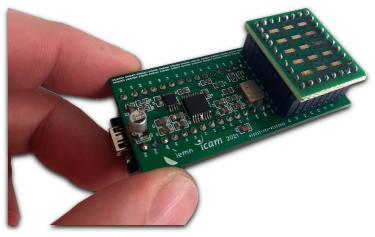 Abstract: Advances on System-On-Chip and organic sensors allows the development of miniaturized impedance measurement hardware for gas monitoring in IoT. In this work, we present the development of miniaturized, multiplexed, and connected platform for impedance sp ectroscopy. Designed for online measurements and adapted to wireless network architectures, our platform has been tested and optimized to be used for multi-selective chemical organic sensor nodes. Our designed circuit is built from low cost and low power consumption (250 mW) microelectronics components that achieve long duration operability (5 days and 16 HRS) without compromising on sensor measurement accuracy and precision. We used the well-known impedance network analyzer AD5933 (Analog Devices, Norw ood, MA, USA) chip which can measure a spectrum of impedances in the range 5 Hz to 100 kHz. The proposed system is based on ESP32-C3 Microcontroller enabling the management of the AD5933 through its I2C interface. Our system benefits from two multiplexer components CD74HC4067 allowing calibration process and the interface of 15 conductimetric sensors with real time acquisition (less than 90 ms per acquisition). The system is capable of relaying information through the network for data analysis and stora ge. The paper describes the microelectronics design, the impedance response over time, the measurement's sensitivity and accuracy and the testing of the platform with embedded chemical sensors for gas classification and recognition.
Routier L., Westrelin A., Cerveaux A., Louis G., Horlac'h T., Foulon P., Lmimouni K., Pecqueur S., Hafsi B.*
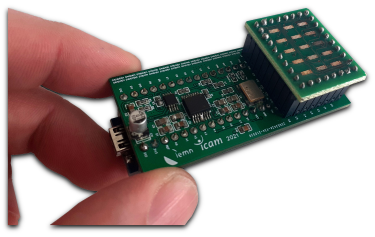 Abstract: Advances on System-On-Chip and organic sensors allows the development of miniaturized impedance measurement hardware for gas monitoring in IoT. In this work, we present the development of miniaturized, multiplexed, and connected platform for impedance sp ectroscopy. Designed for online measurements and adapted to wireless network architectures, our platform has been tested and optimized to be used for multi-selective chemical organic sensor nodes. Our designed circuit is built from low cost and low power consumption microelectronics components providing real time acquisition. The proposed system is based on ESP32 Microcontroller enabling the management of an impedance network analyzer AD5933 (Analog Devices, Norwood, MA, USA) through its I2C interface. Our system benefits from two multiplexer components allowing calibration process and the interface of 15 conductimetric sensors with fast acquisition (less than 90 ms per acquisition). The paper describes the microelectronics design, the impedance respon se over time, the measurement's sensitivity and accuracy and the testing of the platform with embedded chemical sensors for gas classification and recognition.
Routier L., Westrelin A., Cerveaux A., Foulon P., Louis G., Horlac'h T., Lmimouni K., Pecqueur S., Hafsi B.*
Abstract: Surface acoustic waves (SAWs) have a broad spectrum of applications, especially in sensing. However, deposition methods of sensitive layers can be controlled locally through electrodeposition unlike other conventional methods, such as drop-casting and at mospheric-pressure plasma. Employing this method, we experimentally demonstrate the local electrodeposition of PEDOT: PSS on a structured active gold surface. We investigate the response of a piezoelectric transducer at 215MHz, by exploiting shear-horizo ntal (SH) surface waves of the ST-cut quartz substrate. The sensor responses were then tested under acetone, methanol, isopropanol and water vapor gases. Phase changes were more observed under water vapors gases. These changes depended on the surface con ductivity of PEDOT: PSS deposited on the sensor. The double-port SAW gas sensors modified with the PEDOT: PSS presented the highest sensitivity in the case of water vapor, with a maximum phase shift of 0.8º and an insertion loss of about 0.5 dB at ro om temperature. The obtained results could pave the way to implement advanced designs of high-performance and wireless electroacoustic gas sensors based on electropolymerization.
Oumekloul Z., Pecqueur S., de Maistre A., Pernod P., Lmimouni K., Talbi A., Hafsi B.
© 2019-2026 Sébastien Pecqueur


